
Program
Charlie McBride Didn't Invent the Blackshirts. He Perfected Them.
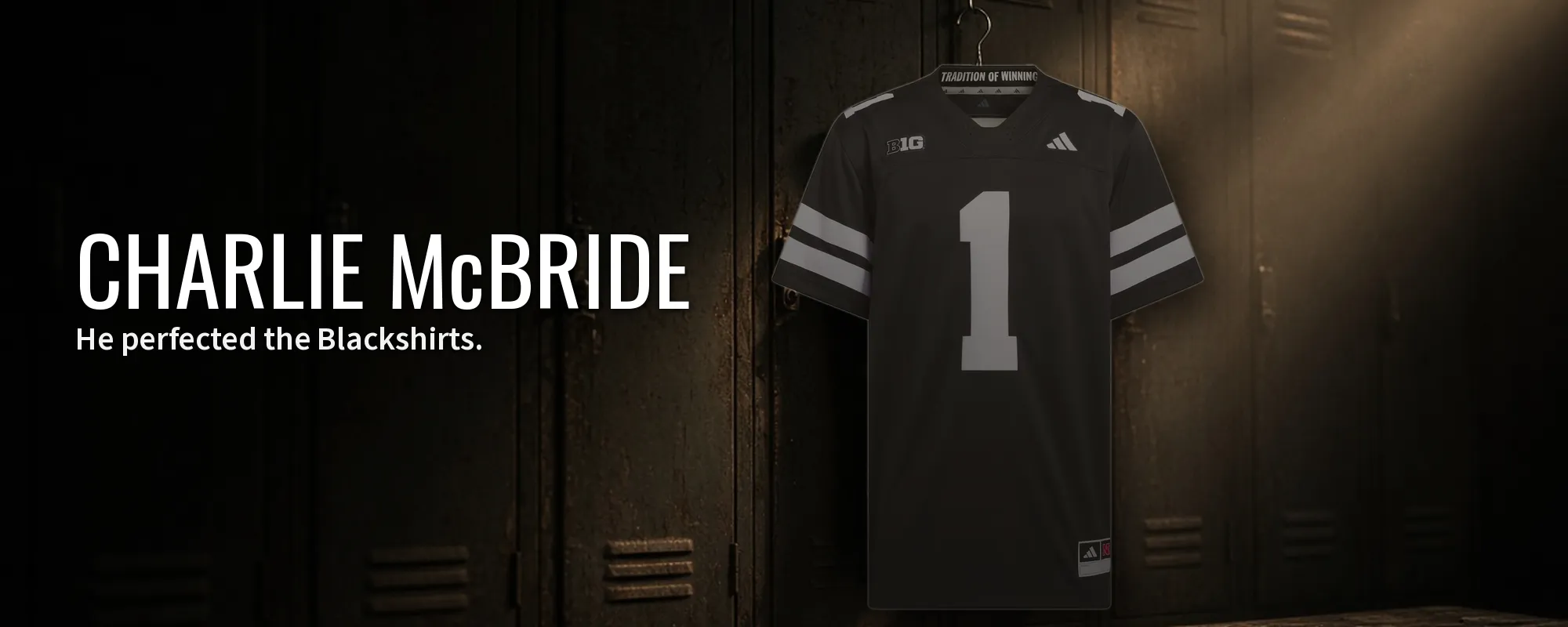
Charlie McBride didn’t invent the Blackshirts. He just made them the most feared practice jersey in college football. Now, at 86, the coach who spent 23 seasons on the Nebraska sideline is in the toughest fight of his life, caring for his wife, Debbie, who is living with severe dementia.
Husker Nation owes him one. Here’s why.
Born in a sporting goods store
The Blackshirts started as an accident. In 1964, after the NCAA allowed two platoon football again, Bob Devaney split Nebraska into separate offensive and defensive units. Assistant Mike Corgan, the staff’s famously frugal equipment buyer, picked up black pullovers at a Lincoln sporting goods store so the defense would stand out in practice. Defensive line coach George Kelly later called it “an accident of availability” and said “the only reason they had black ones was because they didn’t sell.”
Kelly and Jim Ross started yelling “Black Shirts” at practice, and the name stuck by October. The tradition grew under Monte Kiffin. According to Nebraska’s own history of the tradition, it earned national acclaim under Charlie McBride. (You can read the full history of the Blackshirts on our site.)
That’s the line that matters. Devaney’s staff lit the match. McBride built the bonfire.
The call from room 215
McBride wasn’t even a defensive guy for most of his early career. He was an All Big Eight end and punter at Colorado, played a season with the Denver Broncos, coached high school ball in Chicago, then spent years as an assistant at Arizona State under Frank Kush and as Wisconsin’s offensive line coach. Wisconsin moved him to defensive coordinator for one season in 1976.
Then the phone rang at the coaches convention in Miami. McBride told HuskerMax that the caller said “It’s Coach Osborne and I’m down in room 215 right below you.” They talked over dinner at Denny’s, and Tom Osborne offered him the job that night. He started at Nebraska on January 17, 1977, as defensive line coach.
By 1982 he had the coordinator title, and he kept it for 18 seasons.
Turtles no more
Here’s where perfecting comes in. Nebraska’s old 5 2 look was built for the Big Eight’s option offenses. Then came the bowl losses to Miami and Florida State, and McBride saw the problem plain as day.
“When we played Miami and Florida State, we looked like a bunch of turtles on defense,” McBride told the Omaha World Herald. “They were flying all around. We needed to get some speed. And we needed to get pressure on the quarterback.”
So in 1992 he flipped the Blackshirts to a 4 3. Rush ends with a hand in the dirt. Linebackers who could blitz or drop. Cornerbacks playing man to man. Even Osborne was a little nervous at first, according to McBride. “Once we had success, (Osborne) was the guy yelling ‘blitz.’”
The results? Ridiculous. Heading into the Orange Bowl that capped the 1994 season, the Huskers ranked second nationally in points allowed and fourth in total defense. Nebraska won national titles in 1994, 1995 and 1997, and the Wistrom and Peter class went 49 and 2 over four seasons. McBride’s defenses finished in the national top 10 in total defense 11 times, and his 1984 unit led the country.
He went out on top, too. His final defense in 1999 ranked fourth in total defense, third in scoring defense at 12.5 points a game, second in pass efficiency defense and sixth against the run. That was the fifth time since 1946 Nebraska finished top 10 in all four major defensive categories. McBride directed four of the five.
What the shirt meant
Scheme was only half of it. McBride made players understand what that black jersey carried.
“Coach McBride communicated and educated all of us what it meant to get a Blackshirt,” Trev Alberts told Huskers.com. “It wasn’t about us being a Blackshirt. It was about all those people who wore them 10, 15, 20 or 30 years before we did.”
Before bowl games, McBride typically gave every senior defender a Blackshirt at the bowl site to wear during game prep. Four years of work, one last week in black.
And he coached a long list of them. Neil Smith. Broderick Thomas. Trev Alberts. Ed Stewart. Jason Peter. Grant Wistrom, the man McBride called the best defensive end he ever coached. Mike Brown and Ralph Brown on his last defense.
Chew him out, then hug his neck
Ask his players about McBride and they don’t start with X’s and O’s. They start with how he made them feel.
“I was scared to death of him,” Jason Peter told author Paul Koch in an interview published by HuskerMax. “You wanted to please him. Like a father figure, you wanted to please him.”
Peter remembered McBride’s rule: “If you stand there and chew a guy out and tell him ‘you didn’t do good enough’ on one play, then you’ve got to be man enough to walk off the field and hug his neck and tell him you love him and you want the best for him.”
“He taught me everything I know,” Peter said. “He means the world to me, not just as a coach but as a human being.”
Ed Stewart remembered the little things. People who coached with McBride, Stewart told Koch, “talk about the subtlety of a tweak that Charlie would make at halftime, just reposition in alignment by a yard, and that put you in that much better a position to make a play.”
When Grant Wistrom went into the College Football Hall of Fame, he thanked Osborne, McBride and Tony Samuel “for helping me develop as a player on the field and as a man off the field.”
The last win in Tempe
McBride’s final game was the Fiesta Bowl on January 2, 2000, a 31 to 21 win over Tennessee. He didn’t tell the team he was retiring.
“Coach McBride is the type of guy, it’s not his style to tell people that he’s retiring so they play for him,” Mike Brown said after the game. “He’s just someone that, you know, puts his heart into what he does. His players try to give their heart right back to him.”
At the podium, McBride thanked the woman beside him. “I have so many people to thank, especially this one right here, 38 years,” he said of his wife. “She’s a legitimate coach’s wife and raised three legitimate great sons.”
Then he talked about his players. “I honestly love them,” he said. “That’s a word we’re not afraid to use on our football team.”
Frank Solich summed it up: “There’s a reason why Nebraska has had great defensive football teams over the years. Coach McBride is that reason.”
Now it’s our turn
That coach’s wife is Debbie McBride. She was in New York with Charlie when Trev Alberts went into the College Football Hall of Fame.
Today Debbie is living with severe dementia, and her care has become more than one person can carry alone. Charlie is doing everything he can to care for the woman he loves.
Huskers N Arizona, an official University of Nebraska alumni chapter, started a GoFundMe to help. Their words say it best: “Charlie spent decades helping Nebraska win battles on the football field. It is our turn to pay it forward so Charlie can spend more time being a loving husband and less time worrying about the financial demands of her care.”
You can give at Help Charlie McBride a Husker Legend on GoFundMe. No gift is too small, and sharing it with a former player or a fellow fan counts too.
Husker Nation, Charlie McBride spent 23 years showing Nebraska what the Blackshirts stand for. Now we get to show him what Husker Nation stands for.